
Enlarged prostate (BPH): what it is and why it grows
The prostate is a small gland under the bladder, wrapped around the top of the urethra. Its job is to make the fluid that feeds sperm. From about 45, the hormone DHT makes it grow slowly, and as it grows it squeezes the pipe running through its middle.
Its full clinical name for age-related growth is benign prostatic hyperplasia, shortened to BPH. In Swahili the gland is called tezi dume or tezi kibofu. It is not the testicles: the testicles sit outside the body in the scrotum, the prostate sits inside, under the bladder.
Where it sits and what it looks like
It sits directly beneath the bladder, in front of the rectum. The urethra does not pass beside it; it passes through the middle of it, like a pipe through a doughnut. Everything that follows comes from that one fact: when the gland swells, the pipe is squeezed.
In a man of 30 it weighs around 20 grams, about the size of a walnut. By 60 it can reach 40 grams or more. That alone is not a disease; it becomes a problem when it starts affecting urination.
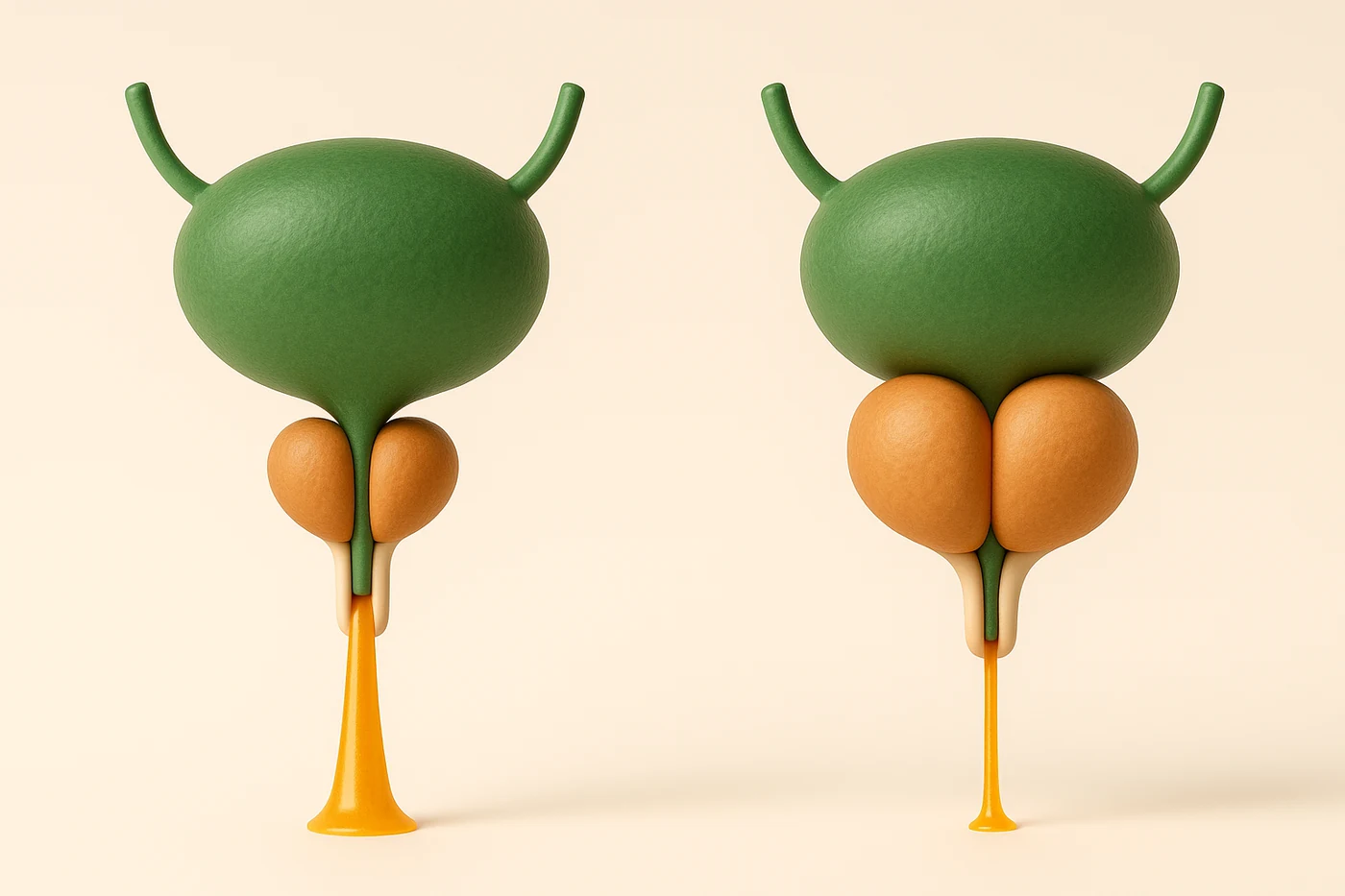
What the prostate does
- Makes seminal fluid. Around a third of semen volume comes from the prostate. That fluid feeds sperm and shields them from acidity.
- Pushes at ejaculation. Its muscle contracts and drives semen out through the urethra.
- Closes the bladder neck during sex. So urine and semen never mix.
Why the prostate enlarges
The driver is hormonal. Testosterone is converted into DHT (dihydrotestosterone) inside the prostate tissue itself, and DHT tells cells to multiply. As age changes the hormonal balance, DHT lingers longer in the tissue. The result is slow growth that continues year after year.
That growth does not care how healthy you feel. Most men discover it five or ten years after it began, when the pipe is narrow enough to change how they urinate.
Six factors that speed the growth up
Age
After 45, DHT (the hormone that drives prostate tissue growth) starts to rise. By 60, more than half of men have an enlarged gland.
Family history
If a father or brother had prostate trouble, your odds roughly double. Start tracking earlier.
Weight and blood sugar
Abdominal weight and type 2 diabetes raise whole-body inflammation, and the prostate is part of the body.
A seated life
Long hours driving or at a desk compress pelvic circulation and keep the swelling in place.
Diet
Heavy red meat and fat with few vegetables is linked to larger glands. Tomatoes, fish and nuts pull the other way.
Low fluid intake
Concentrated urine irritates the urethra lining and makes symptoms feel worse than the actual gland size.
Three different prostate conditions
They get confused because the early symptoms overlap, but they are separate conditions:
| Condition | What it is | Mostly affects |
|---|---|---|
| BPH — benign enlargement | Cell numbers rise with age and hormones | Men 45+ |
| Prostatitis | Inflammation of the gland, often from infection or pelvic strain | Men 25–50 |
| Prostate cancer | Malignant cell growth, often silent at the start | Men 55+ |
How the prostate is examined
Three tests do the work, and all three are available in the larger hospitals in Tanzania:
- PSA blood test. Measures a protein the prostate produces. A high reading does not mean cancer on its own — infection or a simply large gland raises it too. It is a signal to look further, not a diagnosis.
- Digital rectal exam (DRE). The doctor feels the gland through the rectum to judge its size, shape and firmness. It takes seconds.
- Ultrasound and uroflowmetry. These measure the gland's volume and how much urine stays in the bladder after you finish.
If something looks off, the next step is a biopsy — a small tissue sample examined for cell changes. That is the only test that confirms or rules out cancer.
A PSA blood test together with a clinical examination is what separates them. Testing is not something to fear. It is the only way to know which condition you are dealing with.
What comes next
To find out whether your prostate is already affecting urination, go through the nine early prostate symptoms. If you already have them and want to know your options, read prostate treatment options in Tanzania.